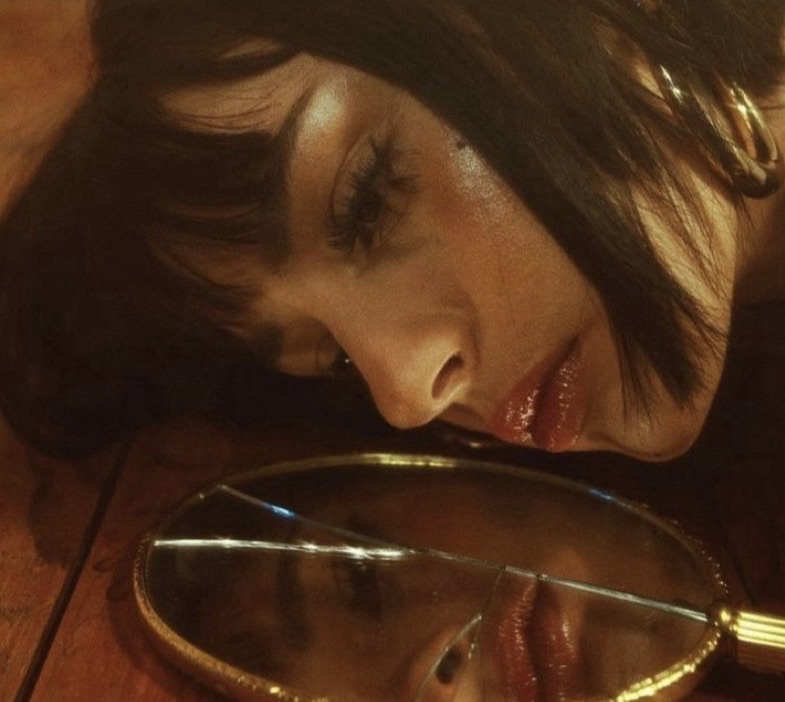
[A literary, modernist-inspired psychological gothic vignette with feminist and speculative undertones.]
It began in silence. Not the sort that follows noise, but the kind that has always been there and waits to be noticed. The room held it carefully. Between the clock’s measured tick and the slight movement of the sheets, something remained untouched. It was not loud enough to interrupt thought, only to direct it. I became aware of it gradually—of how it pressed without pressure, how it lingered just beyond the edge of attention. After a while, it felt less like the room was quiet, and more like the room was listening.
My face.
It was the mirror, of course. It always is. Not shattered, not cracked—no gothic drama. Just glass. Just reflection. And yet—
There was a slight, innocuous moment when I first noticed it. I had been brushing my hair, the morning soft with that peculiar grey light that never seems to belong to any hour, when I caught her watching me. But her head was tilted at an angle I do not remember choosing. Her gaze met mine too directly, too patiently, as if I had finally arrived late to a conversation she had been having alone.
At first, I dismissed it—what else is there to do with such peculiarities? We live by the grace of dismissal! But she remained. Each morning, her presence was a little more pronounced, her eyes more precise.
Mine, but not mine. Mine, distilled.
She is not malevolent, not precisely. But there is a deliberateness in her that unsettles me. She studies me how a child might study a moth—curious but ready to press. She learns quickly. She mimics my gestures with exquisite control. But hers are not softened by hesitation, guilt, or the burden of being perceived. When she smiles, there is no effort to be kind. Her version of me is sharpened, stripped of performance. And perhaps that is what frightens me most.
I have begun to wonder: is she what remains when the scaffolding of self collapses? When the laugh is not offered for comfort but withheld for clarity?
Some days, I feel her in the body before seeing her in the mirror. On the way, my hands tremble without fatigue. On the way, I carry silence like an inheritance. I speak with a voice that feels slightly out of key like a familiar song played with a different key signature—recognizable but not quite right.
And then there are the dreams.
I no longer sleep alone.
She walks ahead of me through hallways that breathe. The walls are organic, slick with a wetness I cannot name. The floor pulses faintly beneath our feet, like the skin of some dormant god. She does not turn to me. She does not need to. I know the shape of my spine when it moves with that kind of purpose. She hums—never a song I know, but always one I remember. Her shadow slips into mine like a hand into a glove.
I wake with a sourness in my mouth and language on my tongue that burns as it dissolves. By morning, the mirror is no longer just glass.
She is already there, waiting.
It would be easy, I think, to call this madness. A brief illness. A symptom. Easier still, perhaps, to label her a projection of grief, of repression, of self-loathing turned outward. But I do not believe in such easy metaphors anymore. She is not a figment. She is not a fragment. She is a fact.
She does not want to replace me. No, she is more patient than that. She wants to coexist. To settle into my skin and share it. I think, perhaps, she has already begun.
There are things she does better than I do. She does not stammer when questioned, flinch when touched, or ache. When I speak through her mouth, the words fall with a clarity I have never known. The world responds to her as it never has to me.
I should resist. I know this. And yet, when she reaches for the brush in the morning and smooths the hair from our face, I do not stop her.
I watch.
And I learn.
- The Animal with My Face[A literary, modernist-inspired psychological gothic vignette with feminist and speculative undertones.] It began in silence. Not the sort that follows noise, but the kind that has always been there and waits to be noticed. The room held it carefully. Between the clock’s measured tick and the slight movement of the sheets, something remained untouched. It was not loud enough to… Read more: The Animal with My Face
- Alberta’s Book Ban: A Dystopian RealityThey say words have power; in Alberta this fall, they are also being held accountable. The weight of this power is evident as classics such as 1984, The Handmaid’s Tale, and Brave New World have been marched off the shelves—not with a bang, but with the muted bureaucracy of a book-ban policy that swept through schools like a disinfectant spray, erasing what it deemed “contaminants.” Now, with the government’s sudden pause on the policy, these books linger in a strange limbo, neither restored to complete freedom nor entirely condemned. It feels less like policy and more like a plot—an unresolved chapter in a dystopian novel that seems determined to write itself.
- Decoding “Sinners:” A Vampire Film with Cultural DepthWhen Ryan Coogler’s Sinners hit theatres this spring, I expected style, atmosphere, and a dose of supernatural dread. What I didn’t expect was a politically charged, allegorical horror epic that tackles cultural appropriation, the cycles of colonization, and the politics of assimilation—all set to the raw pulse of 1930s juke joint blues. This film doesn’t just scare you—it interrogates you.… Read more: Decoding “Sinners:” A Vampire Film with Cultural Depth
- John Hates LemonsA literary short story inspired by Virginia Woolf Author’s Note The seed for “John Hates Lemons” came to me during a Jensen McRae concert. I went not for myself, but because a friend I love suggested her music, and I wanted to share in that joy, even if I couldn’t feel it the same way. I’ve always hated love songs—perhaps… Read more: John Hates Lemons
- Checkpoint Poetics: What a Soviet Poet Taught Me About Moral ResistanceI’ve been thinking a lot about borders; the literal ones drawn across maps, manned by uniformed strangers. And the metaphorical ones—the quiet, invisible lines we learn to draw within ourselves when speaking too loudly, or loving too openly, become dangerous. Lately, I’ve been immersed in the writing of Osip Mandelstam, a Soviet poet who dared to keep writing under Stalin’s… Read more: Checkpoint Poetics: What a Soviet Poet Taught Me About Moral Resistance
- Growing Up With Ghosts: On the Inheritance of FearI was born long after the walls crumbled. After the fig trees were razed, the names of villages became footnotes or forgotten. And yet, I wake with dirt beneath my fingernails — soil I’ve never touched, which stains me still. The ghosts I carry are not made of mist or memory. They are made of silence. Of doorways left open… Read more: Growing Up With Ghosts: On the Inheritance of Fear
 Anxious Thoughts
Leave a comment