
Background
The Israeli-Palestinian conflict embodies a stark injustice, with Palestinians enduring decades of dispossession, displacement, and occupation. Rooted in colonialism and ethnic cleansing, this asymmetrical struggle epitomizes the denial of Palestinian rights and sovereignty. Despite international calls for a two-state solution, it has become increasingly clear that such a framework fails to address the fundamental injustices Palestinians face.
“When Israel declared its establishment in May 1948, it denied that Arab Palestinians had a similar right to statehood as the Jews because the Arab countries had rejected the Partition Plan.”
Noura Erekat
“Pros” of the Two-State Solution
While proponents of the two-state solution argue for its potential to bring peace and stability, the reality on the ground tells a different story. The proposed division of land into separate Israeli and Palestinian states overlooks the deep-rooted inequalities and power imbalances inherent in the conflict. It perpetuates the fragmentation of Palestinian territory through the expansion of illegal Israeli settlements, rendering the notion of a viable Palestinian state increasingly untenable.
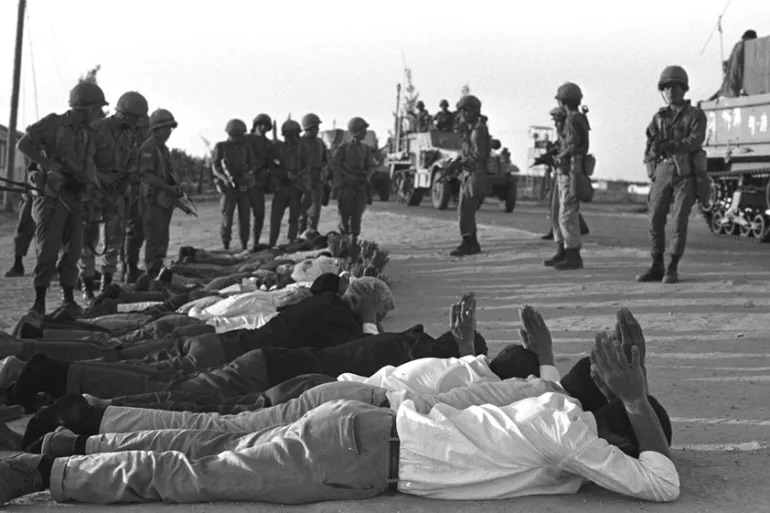
In June 1967, Israel defeated the armies of Egypt, Jordan and Syria, resulting in the Palestinian ‘Nakba’ [File: Reuters]
Challenges and Criticisms
Disagreements over borders and settlements are symptomatic of a broader issue: the systematic erasure of Palestinian rights and identity. The ongoing colonization of Palestinian land, coupled with the denial of fundamental freedoms and rights, undermines any prospects for genuine peace and coexistence.
Jerusalem, revered by Palestinians as their capital, remains under Israeli control, while Palestinian refugees continue to languish in exile, denied their right of return.
The two-state solution fails to address these core grievances, offering Palestinians a truncated and fragmented state devoid of true sovereignty. Instead of fostering peace, it entrenches the status quo of occupation and apartheid, perpetuating the cycle of violence and injustice. The time has come to recognize that genuine peace and justice can only be achieved through the liberation of Palestine from Israeli occupation and the establishment of a single democratic state where all citizens are equal, regardless of religion or ethnicity.
The absence of significant importance given to Palestinian statehood in the resolution did not happen because of intentional sidelining. Instead, it resulted from the political perspective of Palestine at that time.
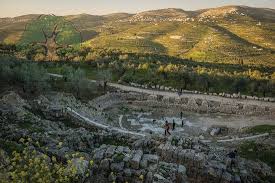
Resolution 242
“(i) Withdrawal of Israel’s armed forces from territories occupied in the recent conflict;(ii) Termination of all claims or states of belligerency and respect for and acknowledgment of the sovereignty, territorial integrity and political independence of every State in the area and their right to live in peace within secure and recognized boundaries free from threats or acts of force.”
BY UN SECURITY COUNCIL RESOLUTION 242, ARTICLE 1
Despite Resolution 242 opening the way for negotiations, it has now become “completely irrelevant,” according to Karmi. She maintains that the most crucial issue that needs resolution in this conflict is the return of Palestinian people to their lands. The Palestinians have been dispossessed of their lands and homes.
Despite several rounds of brokered peace talks, there has been no progress towards implementing a two-state solution. The discussions have come to a stalemate due to the expansion of Jewish settlements. The growing settlement project has brought nearly 600,000 Israelis into dozens of Jewish settlements across the occupied West Bank, which is in clear violation of international law. Israeli authorities frequently confiscate Palestinian land and demolish homes to expand existing settlements or build new ones.
Checkpoints and the separation wall built by Israel have further restricted Palestinians’ freedom of movement. Karmi argues that Israel has complete control over Palestinian territories, including the West Bank and Gaza.
The Gaza Strip, which is home to about two million people, has been under siege for over a decade. Israel imposed a strict blockade on land, air, and sea in 2007.
According to Karmi, Israel’s complete control over 100% of Palestine is the fundamental reason why a two-state solution cannot be achieved.
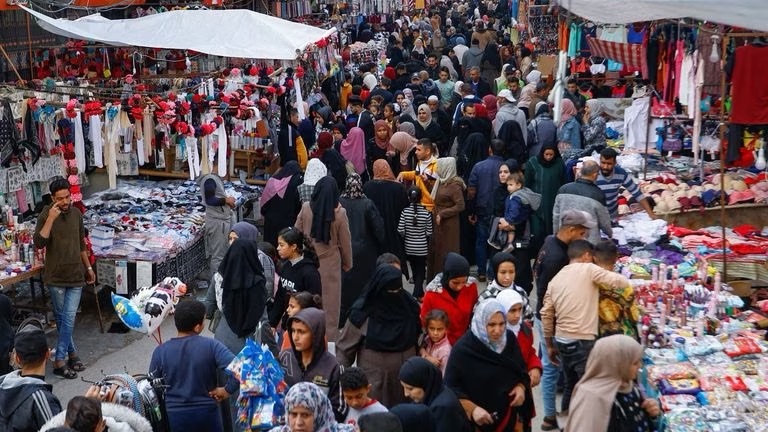
Khan Younis, southern Gaza, earlier this year
Conclusion
The two-state solution is a flawed and inadequate framework for resolving the Israeli-Palestinian conflict. It perpetuates the subjugation of the Palestinian people and entrenches the colonial project of Israeli expansionism.
With the Israeli bombardment of Gaza continuing for almost seven months, renewed talks about a two-state solution have emerged, but that is not a viable solution.
The international community must heed the calls for justice and solidarity with Palestine, advocating for a just and equitable solution based on the principles of human rights, equality, and self-determination.
Only through the liberation of Palestine can true peace and justice be achieved for all its inhabitants.
- The Animal with My Face
 [A literary, modernist-inspired psychological gothic vignette with feminist and speculative undertones.] It began in silence. Not the sort that follows noise, but the kind that has always been there and waits to be noticed. The room held it carefully. Between… Read more: The Animal with My Face
 - Alberta’s Book Ban: A Dystopian Reality
 They say words have power; in Alberta this fall, they are also being held accountable. The weight of this power is evident as classics such as 1984, The Handmaid’s Tale, and Brave New World have been marched off the shelves—not with a bang, but with the muted bureaucracy of a book-ban policy that swept through schools like a disinfectant spray, erasing what it deemed “contaminants.” Now, with the government’s sudden pause on the policy, these books linger in a strange limbo, neither restored to complete freedom nor entirely condemned. It feels less like policy and more like a plot—an unresolved chapter in a dystopian novel that seems determined to write itself.
 - Decoding “Sinners:” A Vampire Film with Cultural Depth
 When Ryan Coogler’s Sinners hit theatres this spring, I expected style, atmosphere, and a dose of supernatural dread. What I didn’t expect was a politically charged, allegorical horror epic that tackles cultural appropriation, the cycles of colonization, and the politics… Read more: Decoding “Sinners:” A Vampire Film with Cultural Depth
 - John Hates Lemons
 A literary short story inspired by Virginia Woolf Author’s Note The seed for “John Hates Lemons” came to me during a Jensen McRae concert. I went not for myself, but because a friend I love suggested her music, and I… Read more: John Hates Lemons
 Anxious Thoughts
Leave a comment