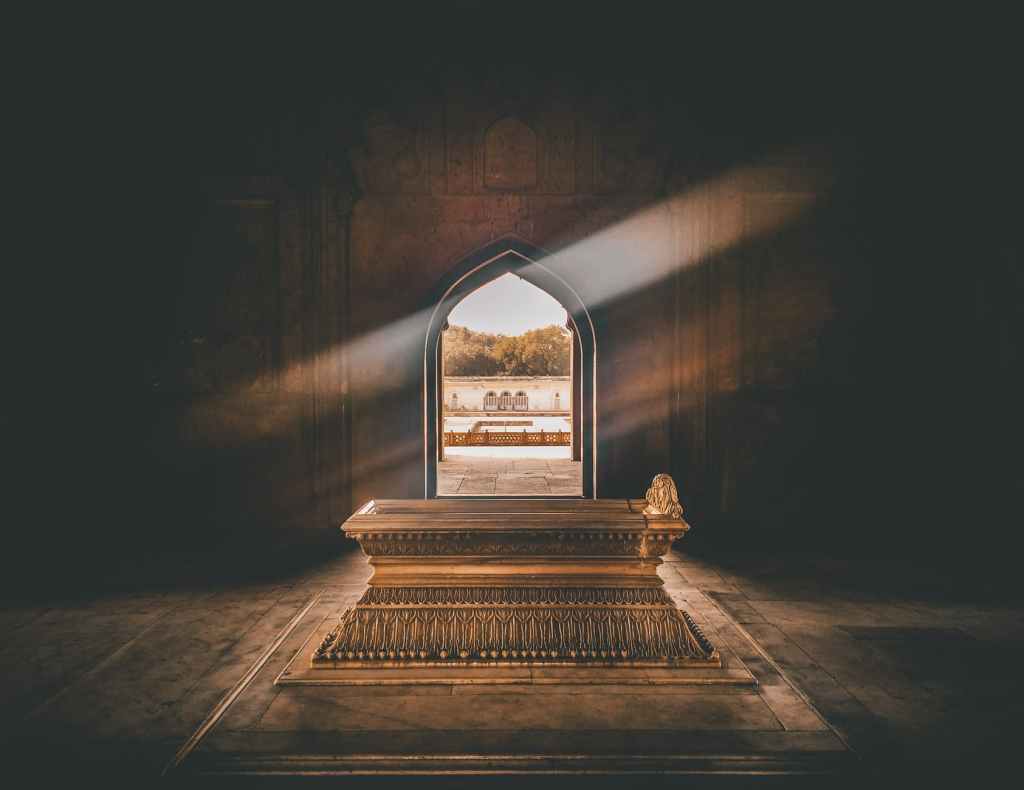
It was an odd sized casket, too small for a man, too big for a child. A flag was draped over it, a smallish one. It was carried by four men in uniform, though it was hard to tell for sure from a distance what uniform it was, or even if they were all men. There wasn’t room for the usual six pallbearers due to the small size of the casket since it would have made for a comical service to have all six jammed together, shoulder-to-shoulder, crowding around an undersized coffin. So the extra pallbearers were in the ranks of many others in uniform standing beside a small open grave. The officiant wore a robe instead a uniform and must have said something because there was a long silence, then a burst of laughter.
“I knew Raymond on a personal level, and there was never a dull moment with him,” he smiled faintly, then continued to amuse the crowd with anecdotes involving Raymond’s early years. Cladded in black, people gathered around the grave, holding one another as they relived the time spent with this man through distant memories and humorous narratives. It was a rather gloomy day, yet there was a glow surrounding the casket.
I used to come to the cemetery often during my teenage years, and no, it wasn’t to impress the goth kids at my school. I had a fascination for death, in some ways I had always envied the deceased. Of course, my appeal resulted in me being the weird son of a single mother. I’ve been to many therapists who’ve tried to crack me open and understand what childhood trauma must have caused this interest. And I had memorized people’s sympathetic slopes when my mother told them I was depressed. I wasn’t though. I admired the idea of death for it meant that time had to halt, and I’ve never met anyone who hasn’t hoped for that at some point. Serene moments were hard to find, especially as a secondary school student embarking on the future, but the cemetery had this ironic tranquility surrounding it. As my classmates scurried to fill out college applications, woefully struggling to invent a new software, or perhaps even become the next president, I felt as if I was running aimlessly towards nothing, trying to accomplish what others have already done. And I always contemplated what it meant to lead a significant life.
I encountered a lot of funerals at this cemetery, but there were never like this one. Instead of scowls and weeping expressions, smiles were growing fonder with every story people shared. Laughter thronged the space as if this was a celebration rather a funeral. They weren’t mourning Raymond’s death; they were honouring his existence.
After a short moment of silence, a young woman struggled to speak, “I had always promised my dad that I wouldn’t cry during his funeral, so forgive me if my voice sounds weak,” the crowd murmured. “My father was just like any other man trying to get by in life, but what made him special was his laughter, he carried it with him everywhere. Anyone who would meet him could tell how much joy he held, there was never a single room he couldn’t brighten up.” Agreeing nods and grins appear.
Something forced me to sit through the ceremony, something I couldn’t identify for a long time. I didn’t know this man, yet I caught myself smiling at some of his stories. I learned that Raymond was a Mathematics teacher who loved his students greatly. He met his wife at a rally for human rights- according to one of the people’s stories-, and he had two girls who were standing next to each other. From the way some of the people were dressed, I guessed that Raymond might have served in the military, I’ve considered doing that as well. His life felt strangely familiar, and I wondered why I sensed this connection towards him. Some of the things he had accomplished were still goals for me.
His daughter finalized her speech, followed by a light applause. Some boys who looked my age stepped closer balancing their trumpets on their narrow shoulders. A weary boy began to articulate, “I promised Raymond to play his favourite song at his funeral, and I always hoped that that day would never come, yet here we are,” his forehead creased, and he swallowed the knot in his throat. With a weakness to his voice, he said “To the best grandfather a child could ask for,” and grasped his instrument as the crowd cheered. The boys began playing and oddly enough they played my favourite song, “Candle in the Wind” by Elton John. I couldn’t help but faintly mumble along to the lyrics and for a minute I forgot why I was here. I scoffed at the realization that I was tearing up over a stranger.
I steered my attention away from the ceremony for a while and leaned back on the damp grass. As people reminisced Raymond’s long life, I began remembering mine. I mourned over the fact that most of my memories were dreadful, filled with moments I wished I could erase. If the course of my life had been different, maybe I could have lived a life as fulfilling as Raymond’s. I envied the old man, not over his death this time, but over the life he led. Even after withering away, he still made people joyous.
The performance ended as the boys plunged their instruments to the earth. Few people were fighting away tears, some were still humming the song. An elderly woman stepped forward, introduced herself as Raymond’s wife, “We always talk about wishing to be remembered after we die, wanting to leave a legacy behind” the sheet in her hand was shaking, her breath uneasy. “And Raymond saw how pressured most students were to achieve greatness, often steering them to crash upon themselves. Raymond was a simple teacher; yet he was a legend in all of our eyes. He made me realize that your life could be measured by moments spent with loved ones and the influence you’ve had on others. My husband’s legacy lives in all of us, and he will be remembered through our memories, songs and loving embraces.” The woman’s shoulders drooped down, she seemed too frail to stand. Held by her two daughters, they patted her back consolingly.
The officiant took over again to conclude the ceremony, touching upon Raymond’s hardships. I was surprised to learn that this man didn’t have such a comfortable upbringing. Raised by immigrant parents, and forced to live off nothing for years, Raymond never gave up on his life. I couldn’t help but reflect on my circumstances. I had always looked at content people with fixed prejudice. Of course they’re happy, why wouldn’t they be? However, I never realized that happiness was attainable for me as well, I had never considered it.
I shot a glance over to the group of people, seeing the old man’s wife gripping a book, his two daughters standing beside their mother, and Raymond peacefully lying in his casket. Their faces beamed with happiness, as if they were the most fortunate people on Earth to have known Raymond. I questioned how he managed to turn a funeral into a delightful event. Is it because he died with no regrets? Or because he died knowing his family would be by his side, their eyes full of love. It was a beautiful sight, and I wondered if I would be able to create something this magnificent with my life.
I didn’t have such an easy upbringing myself, and I used to attend a prestigious school thanks to my mother who managed two jobs. She always used to tell me that life is more than simple pleasures and artificial success. It’s the moments you spend with loved ones, the impact you have, and the light your soul holds. I never believed her though. I constantly scoffed at her positive outlook. “Look at the glass half-full,” she would say, why would I? I had my fixed definition of happiness and grouped it with materialistic things. So, in my mind, if I didn’t have these things, I didn’t have happiness.
However, here I was facing a man who proved me wrong. A man whose happiness was available all around. The number of people who gathered to celebrate his life was incredible. To think that a simple man could leave behind this much impact. Perhaps life is not as complicated to understand.
The sky darkened, and the clouds bundled up above Raymond’s grave, ready to receive him. A few droplets of rain pelted the casket creating a melody for the old man, as if reassuring him that he had lived a good life. I noticed that my hand was trembling though the weather was sweltering. I felt an urge to approach the casket, so I reluctantly walked over to where the gathering was, something steered me towards Raymond.
The second daughter was sharing a story about when her father got a fraud call about an arrest issued in his name and how he was panicking and bawling, “I will go to prison.” Laughter grew higher with each story, and I chuckled too. My mother always teased me for believing every fraud call I got, and that memory used to hold such negativity, yet I was laughing to it at that moment.
“Raymond never got used to mobile phones, he always complained about the inconvenience of carrying it everywhere and the stress that comes with forgetting it somewhere,” another person spoke. The old man seemed pleasant to be around, I wished I got to know him during my life. Something felt strange though. The stories being shared seemed too familiar.
My mind was scattered, Raymond’s memories played repeatedly until I began mistaking them for my own. I looked down at my feet, trying to regain myself. My shadow created an odd shape, a shape of a man who seemed greater than me. I sensed my feet dig deeper into the ground, as if something, or someone, was beckoning me. Although I had a plan for my life to end after my graduation, I felt my gloom pulling me away from that. Suddenly, death didn’t strike as appealing as it once did, and I sought time to proceed.
As they prepared to roll the casket down, one of the daughters noticed my presence and approached me. She had one of the warmest smiles, and with calmness she introduced herself. She asked how I knew her father, and I said that we were acquaintances. “He saved my life,” I proclaimed, and I still don’t understand why I owed my life to this man, but I did. She placed her hand on my shoulder and squeezed, then inquired about my name. “It’s Raymond,” I replied.
As the family gathered around the grave, ready to say one closing goodbye, I walked away. I breathed in for the first time in so long, finally feeling something. I saw my life flash in front of me, and my future seemed nice enough to look forward to it. I realized then and there that I didn’t require to do something considerable to die greatly, I just needed to live, and I was excited for that.
The grave wasn’t ready until sunset, so the whole event was rushed and disorganized, except for the very last part. The grave was a massive affair, more of a crater than a grave, and it took until dark to roll the casket down to the bottom. If any prayers were said, they couldn’t be heard over the dull thudding of the clods raining down on the casket far below. It was an odd-sized casket, too big for a man, too small for a dream, but just right for a dynasty.
Help Support My Work!
Make a one-time donation
Make a monthly donation
Make a yearly donation
Choose an amount
Or enter a custom amount
Your contribution is greatly appreciated.
Your contribution is appreciated.
Your contribution is appreciated.
DonateDonate monthlyDonate yearlyThis short story was written for the Owl Canyon Short Story Contest. The winners have been announced, and since I wasn't among them, I decided to share the story here. I highly urge you to go read the winners' short stories as they are innovative and wonderfully written. Note that the first and last paragraphs were given to us, and we had to write the 18 paragraphs in the middle to form 20 paragraphs. I hope you enjoy this simple fiction.
 Anxious Thoughts
Leave a comment